TU97: The Dynamic Maturational Model (DMM) of Attachment With Guest Patricia Crittenden (Part 2)

by | May 29, 2019 | Attachment, Episodes, Guest Interviews, Therapy, Trauma

Show Notes

Note: This episode is Part 2 of 2. It stands alone, but to start at Part 1 click HERE.  

“So which strategy in this model is best? Every behavioral strategy is the right strategy for some problem, but no strategy is the best strategy for every problem. We need them all.”

– Dr Patricia Crittenden, creator of the Dynamic Maturational Model of Attachment & Adaptation (DMM) using culture and context.

LOOKING FOR THE SLIDES?

DOWNLOAD THE PDF HERE: Rudiments-of-the-DMM-PDF VERSION

OR THE POWERPOINT VERSION HERE:  Rudiments of the DMM Powerpoint version 

Or if you have great eyesight 🙂 you can view them here.
The Dynamic maturational model


Therapist Uncensored Episode 97 Show Notes:

Before we begin:

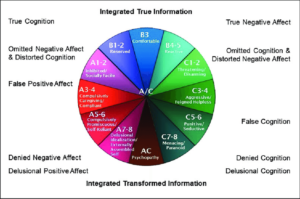
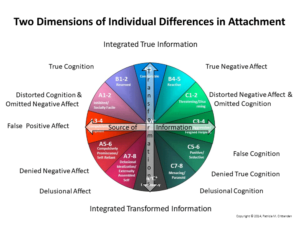
  • A’s (Red in the DMM)=Historically referred to as Blue on TU
  • B’s (Blue in the DMM)=Historically referred to as Green on TU
  • C’s (Green in the DMM)=Historically referred to as Red on TU
  • AC’s = Historically referred to Tie Dye on TU

**Note: We know the colors may be a bit confusing, but it is important to us that you receive information as Dr Crittenden has published it. It is by happenstance that our colors are the same (with the exception of tie dye), but they represent different thinking and behavioral patterns. When we refer to color in the episodes and in the show notes, we are referring to the colors we have historically used on the TU podcast and the letters and self-protective strategies of the DMM. This is only in order to maintain consistency and make the information more easily understood by our listeners. However, the colors as shown in the slides and as listed above, are the way Dr Crittenden uses them in her fantastic work!

Let’s Dive In:

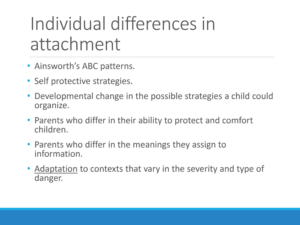
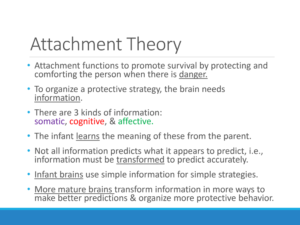
To understand self-protective strategies, we have to understand the information the brain is using, even in infancy – it’s neurological.

A’s, the B’s and the C’s emphasize different sorts of information.

Strategies by Age Group and Model Representation:


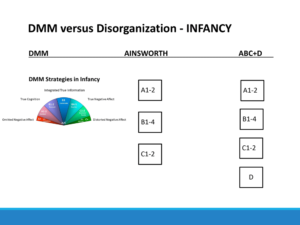
Infancy

DMM                           Ainsworth                ABC+D

A-2: Avoidant                           A1-2                    A1-2

B1-2: Reserved                    B1-4                    B1-4

B3: Comfortable                    C1                       C1-2

B4-5: Reactive                                              D-Controlling

C1-2: Resistant/Passive


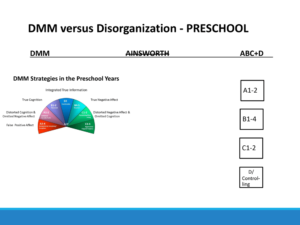
Preschool

  • Preschoolers utilize false positive affect.
  • A’s split their own self from the other, and they focus on the parent. They take the perspective of the powerful person.
  • C’s split their negative affect, showing either the vulnerable or the invulnerable affect. They hide the other from view.

DMM                             Ainsworth               ABC+D

A1-2: Avoidant                                                 A1-2

A3-4: Compulsively Caregiving/Compliant      B1-4

B1-2: Reserved                                               C1-2

B3: Comfortable                                               D-Controlling

B4-5: Reactive

C1-2: Resistant/Passive

C3-4: Aggressive/Feigned Helpless

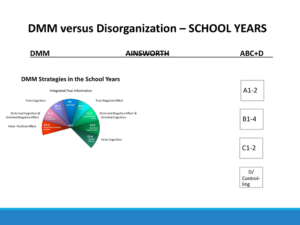
School Age

DMM                             Ainsworth               ABC+D

A1-2: Avoidant                                                 A1-2

A3-4: Compulsively Caregiving/Compliant                       B1-4

B1-2: Reserved                                                C1-2

B3: Comfortable                                          D-Controlling

B4-5: Reactive

C1-2: Resistant/Passive

C3-4: Aggressive/Feigned Helpless

C5-6: Punitive/Seductive


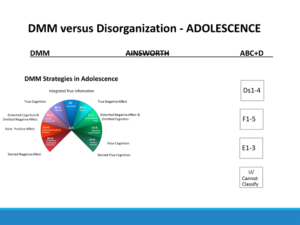
Adolescence

DMM                             Ainsworth               ABC+D

A1-2: Avoidant                                                 A1-2

A3-4: Compulsively Caregiving/Compliant                        B1-4

A5-6: Compulsively Promiscuous/Self-Reliant                    C1-2

B1-2: Reserved                                          U/Cannot Classify

B3: Comfortable

B4-5: Reactive

C1-2: Resistant/Passive

C3-4: Aggressive/Feigned Helpless

C5-6: Punitive/Seductive


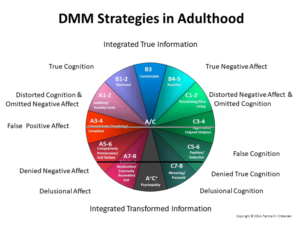
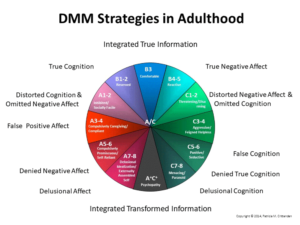
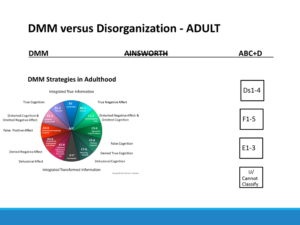
Adult

DMM                               Ainsworth                    ABC+D

A1-2: Avoidant                                                        A1-2

A3-4: Compulsively Caregiving/Comp                    B1-4

A5-6: Compulsively Promiscuous/Self-Reliant        C1-2

A7-8: Delusional Idealization/Externally Assembled Self              U/Cannot Classify

B1-2: Reserved

B3: Comfortable

B4-5: Reactive

C1-2: Resistant/Passive

C3-4: Aggressive/Feigned Helpless

C5-6: Punitive/Seductive

C7-8: Menacing/Paranoid

A/C: Includes Psycopathy (extreme A/C combination)


Description of each group:*

The A’s (our blue. red in the DMM)

A1-2: The A1-2 strategy uses cognitive prediction in the context of very little real threat. Attachment figures are idealized by over-looking their negative qualities (A1) or the self is put down a bit (A2). Most A1-2s are predictable, responsible people who are just cool and businesslike. Type A strategies all rely on inhibition of feelings and set danger at a psychological distance from the self. This strategy is first used in infancy.

A3: Individuals using the A3 strategy (compulsive caregiving, cf., Bowlby, 1973) rely on predictable contingencies, inhibit negative affect and protect themselves by protecting their attachment figure. In childhood, they try to cheer up or care for sad, withdrawn, and vulnerable attachment figures. In adulthood, they often find employment where they rescue or care for others, especially those who appear weak and needy. The precursors of A3 and A4 can be seen in infancy (using the DMM method for the Strange Situation), but the strategy only functions fully in the preschool years and thereafter.

A4: Compulsively compliant individuals (Crittenden & DiLalla, 1988) try to prevent danger, inhibit negative affect and protect themselves by doing what attachment figures want them to do, especially angry and threatening figures. They tend to be excessively vigilant, quick to anticipate and meet others’ wishes, and generally agitated and anxious. The anxiety, however, is ignored and downplayed by the individual and often appears as somatic symptoms that are brushed aside as being unimportant.

A5: A5 individuals use a compulsively promiscuous strategy (Crittenden, 1995) to avoid genuine intimacy while maintaining human contact and, in some cases, satisfying sexual desires. They show false positive affect, including sexual desire, to little known people, and protect themselves from rejection by engaging with many people superficially and not getting deeply involved with anyone. This strategy develops in adolescence when past intimate relationships have been treacherous, and strangers appear to offer the only hope of closeness and sexual satisfaction. It may be displayed in a socially promiscuous manner (that does not involve sexuality) or, in more serious cases, as sexual promiscuity.

A6: Individuals using a compulsively self-reliant strategy (Bowlby, 1980) do not trust others to be predictable in their demands, find themselves inadequate in meeting the demands or both. They inhibit negative affect and protect themselves by relying on no one other than themselves. This protects the self from others, but at the cost of lost assistance and comfort. Usually this strategy develops in adolescence after individuals have discovered that they cannot regulate the behavior of important, but dangerous or non-protective, caregivers. They withdraw from close relationships as soon as they are old enough to care for themselves. There is a social form of the strategy in which individuals function adaptively in social and work contexts, but are distant when intimacy is expected, and an isolated form in which individuals cannot manage any interpersonal relationship and withdraw as much as possible from others.

A7-8: Delusionally idealizing individuals (Crittenden, 2000) have had repeated experience with severe danger that they cannot predict or control, display brittle false positive affect, and protect themselves by imagining that their powerless or hostile attachment figures will protect them. This is a very desperate strategy of believing falsely in safety when no efforts are likely to reduce the danger (cf., the “hostage syndrome”). Paradoxically, the appearance is rather generally pleasing, giving little hint of the fear and trauma that lie behind the nice exterior until circumstances produce a break in functioning. This pattern only develops in adulthood.

Individuals using an A8 strategy (externally assembled self, Crittenden, 2000) do as others require, have few genuine feelings of their own, and try to protect themselves by absolute reliance on others, usually professionals who replace their absent or endangering attachment figures. Both A7 and A8 are associated with pervasive and sadistic early abuse and neglect.

The B’s (our green, blue in the DMM)

B1-2: Individuals assigned to B1-2 are a bit more inhibited with regard to negative affect than B3s but are inherently balanced.

B3: The Type B strategy involves a balanced integration of temporal prediction with affect. Type B individuals show all kinds of behavior but are alike in being able to adapt to a wide variety of situations in ways that are self-protective, that protect their children, and that as often as possible cause others no harm. They communicate directly, negotiate differences, and find mutually satisfactory compromises. They distort cognitive and affective information very little, especially not to themselves.

Finally, they display a wider range of individual variation than people using other strategies – who must constrain their functioning to employ their strategy. This strategy functions in infancy. By adulthood, two sorts of Type B strategies can be differentiated. Naive B’s simply had the good fortune to grow up in safety and security. Mature B’s, on the other hand, 1) have reached neurological maturity (in the mid-30’s), 2) function in life’s major roles, e.g., child, spouse, parent, and 3) carry out an on-going process of psychological integration across relationships, roles, and contexts. Where naive B’s tend to be simplistic, mature B’s grapple with life’s complexities.

B4-5Individuals assigned to B4-5 exaggerate negative affect a bit, being sentimental (B4) or irritated (B5) but are inherently balanced.

The C’s (our red, blue in the DMM)

 C1-2: The C1-2 (threatening-disarming) strategy involves both relying on one’s own feelings to guide behavior and using somewhat exaggerated/changing displayed negative affect to influence other people’s behavior. Specifically, the strategy consists of splitting, exaggerating, and alternating the display of mixed negative feelings to attract attention and manipulate the feelings and responses of others. The alternation is between presentation of a strong, angry invulnerable self who blames others for the problem (C1,3,5, 7) with the appearance of a fearful, weak, and vulnerable self who entices others to give succorance (C2,4,6,8). C1-2 is a very normal strategy found in people with low risk for mental health problems and a great zest for life. Infants display the C1-2 strategy.

C3-4: The C3-4 (aggressive-feigned helpless) strategy involves alternating aggression with apparent helplessness to cause others to comply out of fear of attack or assist out of fear that one cannot care for oneself. Individuals using a C3 (aggressive) strategy emphasize their anger in order to demand caregivers’ compliance. Those using the C4 (feigned helpless) give signals of incompetence and submission. The angry presentation elicits compliance and guilt in others, whereas vulnerability elicits rescue. The precursors of this strategy can be seen in infancy (using the DMM method for the Strange Situation), but the strategy only functions fully in the preschool years and thereafter.

C5-6: The C5-6 strategy (punitively obsessed with revenge and/or seductively obsessed with rescue) is a more extreme form of C3-4. It involves active deception to carry out the revenge or elicit rescue. Individuals using this strategy distort information substantially, particularly in blaming others for their predicament and heightening their own negative affect. The outcome is a more enduring and less resolvable struggle.

Those using a C5 (punitive) strategy are colder and more distant

Recent Episodes

Mind, Body, Heart, Spirit: Embodying Liberation Psychology with Dr. Shena Young – Replay – (285)

Mind, Body, Heart, Spirit: Embodying Liberation Psychology with Dr. Shena Young – Replay – (285)

Replay – Join co-host Sue Marriott and Dr. Shena Young as they dive into liberation psychology and the conflict between intuition and the traditional European model of psychology. Dr. Shena highlights embodying a holistic approach to help heal traumas and deeply root us in our most authentic selves. Whether through connections with nature or the exploration of ancestral traditions, this discussion is enriched with various opportunities to reconnect and liberate our mind, body, heart, and spirit.

read more
Family Estrangement: The Space Between Love & Self-Protection with Dafna Lender (284)

Family Estrangement: The Space Between Love & Self-Protection with Dafna Lender (284)

Dr. Ann Kelley is joined LIVE from Psychotherapy Networker with Dafna Lender, to explore the complex dynamics of parent-child estrangement. Focusing on the emotional and psychological impacts of cutting off family relationships, together they highlight the cultural influences that contribute to these estrangements, the therapeutic perspectives on navigating such situations, and the importance of empathy and boundaries in managing family dynamics. This conversation is about learning to hold both empathy and boundaries – understanding why someone might step away, and how to stay grounded and compassionate in the process. It’s an honest look at the heartbreak, the healing, and the hope that can emerge when families face difficult truths. View the full episode shownotes at TherapistUncensored.com/TU284

read more
Autism in Polyvagal Terms with Dr. Sean Inderbitzen (283)

Autism in Polyvagal Terms with Dr. Sean Inderbitzen (283)

Join host Sue Marriott and guest Dr. Sean Inderbitzen – an autistic psychotherapist and advocate for neurodiversity – as he shares his powerful personal and professional journey in understanding autism. Together, they explore the evolution of autism diagnosis, the intersections between attachment and neurodivergence, and how polyvagal theory can both illuminate and complicate the autistic experience. Dr. Inderbitzen offers insights on self-diagnosis, identity formation, and what truly person-centered therapy looks like for autistic individuals. This conversation highlights the central role of trust, safety, and authentic connection in helping neurodivergent clients thrive. You can view the full shownotes at TherapistUncensored.com/TU283.

read more
Saving Relationships in a Polarized World: Bill Doherty on Citizen Therapists & Political Healing (281)

Saving Relationships in a Polarized World: Bill Doherty on Citizen Therapists & Political Healing (281)

Dr. Ann Kelley sits down with Dr. Bill Doherty to explore the idea of “Citizen Therapists” and how therapists — and all of us — can help bridge divides in a polarized world. Together, they dive into discernment counseling for couples on the brink of divorce, the groundbreaking work of Braver Angels in fostering dialogue across political differences, and the skills we all need for hard but healing conversations. This conversation highlights the power of curiosity, respectful boundaries, and understanding – whether in our closest relationships or across society. View the full episode show notes at TherapistUncensored.com/TU281

read more
Bonus – Harnessing “Genius Energy”: The Art of Wise Effort for Growth with Dr. Diana Hill (280)

Bonus – Harnessing “Genius Energy”: The Art of Wise Effort for Growth with Dr. Diana Hill (280)

Ann Kelley and Diana Hill dive into the concept of wise effort and its impact on how we manage our energy in both personal and professional life. They explore the difference between life force energy and anxiety, the role of emotional sensitivity, and why community resilience matters. Diana shares insights on how to wisely channel your “genius energy,” break free from stuck patterns, and cultivate compassionate connections that support growth and balance. Listen to the full episode at TherapistUncensored.com/TU280

read more
Why Diets Don’t Work—and What to Do Instead with Judith Matz (277)

Why Diets Don’t Work—and What to Do Instead with Judith Matz (277)

Dr. Ann Kelley and expert Judith Matz unpack the complex relationship between dieting, emotional eating, body image, and weight stigma. Together they challenge conventional views on weight and health, emphasizing that fitness matters more than the number on the scale, and explores why most diets fail both psychologically and physiologically. They also cover the historical roots of fatphobia, the dangers of weight
bias in healthcare, and the rise of weight loss drugs like Ozempic. Judith highlights the importance of attuned eating, informed consent, and compassionate care, offering a weight-inclusive approach to healing our relationship with food and body. View full episode shownotes at TherapistUncensored.com/TU277

read more
Feel It to Heal It: The Science of Interoception with Rebecca Kase (274)

Feel It to Heal It: The Science of Interoception with Rebecca Kase (274)

Sue Marriott is joined by Rebecca Kase to explore how understanding the nervous system—especially the
concept of interoception—can support healing from trauma. Rebecca shares her personal story as a survivor and highlights the importance of creating safety, tuning into the body’s internal signals, and approaching somatic work with compassion. Together, they unpack how interoception differs from general perception, why it matters in therapy, and how small, gradual steps can help rebuild connection with the body. View full shownotes at TherapistUncensored.com/TU274.

read more
That “Fraud” Feeling: The Surprising Truth About Imposter Syndrome with Dr. Jill Stoddard (273)

That “Fraud” Feeling: The Surprising Truth About Imposter Syndrome with Dr. Jill Stoddard (273)

Dr. Ann Kelley is joined by Dr. Jill Stoddard as they unpack the complexities of imposter syndrome—why it shows up, who it impacts most, and how to move through it. Drawing on her expertise in psychological flexibility and values-based living, Dr. Stoddard shares strategies to navigate self-doubt, marginalization, and internalized insecurity. Learn how to reframe discomfort, build a healthier relationship with vulnerability, and use these moments as powerful opportunities for connection and growth. Join our exclusive neuronerd community – TherapistUncensored.com/Join

read more
From Zimbabwe to New York City, Expanding Quality Mental Health Access – the Friendship Bench with Dr. Dixon Chibanda (272)

From Zimbabwe to New York City, Expanding Quality Mental Health Access – the Friendship Bench with Dr. Dixon Chibanda (272)

Grounded in research and lived experience, this conversation invites a rethinking of care—away from over-medicalization and toward more accessible, human-centered approaches. Dixon Chibanda shares the powerful story behind the Friendship Bench, a community-based mental
health model that centers healing in the heart of local communities. He explores how grandmothers—often overlooked in traditional mental health systems—play a vital role in offering care, connection, and wisdom. Dr. Chibanda discusses the barriers to accessing mental health services, the role of storytelling in the healing process, and the global expansion of the Friendship Bench. Grounded in research and lived experience, this conversation invites a rethinking of care—away from over-medicalization and toward more accessible, human-centered approaches. View this episodes shownotes at TherapistUncensored.com/TU271 – Join our exclusive online community at TherapistUncensored.com/Join

read more
What is Real Allyship When it Comes to White Women and Racial Trauma with Dr. Monnica Williams (271)

What is Real Allyship When it Comes to White Women and Racial Trauma with Dr. Monnica Williams (271)

Dr. Monnica Williams alongside Sue Marriott explore the deep psychological toll of racism, focusing on the concept of racial trauma and its cumulative impact on people of color. She highlights the importance of recognizing these experiences within therapeutic settings and the need for diversity in mental health research and practice. The discussion delves into the role of civil courage and meaningful allyship—particularly among white individuals in addressing systemic injustice. Dr. Williams offers insights into the multifaceted nature of activism, the harm caused by microaggressions, and the emotional labor involved in navigating everyday racism. From the fear of law enforcement to the unique challenges faced by white women in activism, Dr. Williams urges practitioners and allies alike to listen deeply, receive feedback openly, and use their privilege to support marginalized communities. Shownotes: www.therapistuncensored.com/TU271 Join online community: www.therapistuncensored.com/join

read more
Bonus – Amplify Your Voice: Reflections on Mental Health & Meaningful Practice (270)

Bonus – Amplify Your Voice: Reflections on Mental Health & Meaningful Practice (270)

Let’s get real about revitalizing the therapy landscape

Ann Kelley and Sue Marriott are back for a one on one episode, and sharing their personal reflections on
mental health, community, and the evolving challenges clinicians face today. From the tension between accessibility and sustainability in therapy, to the influence of corporate models – they discuss the need for creativity in the field. Emphasizing connection, curiosity, and professional growth, they introduce exciting opportunities, updates, and even a new series focused on inclusivity – inviting listeners to find and amplify their unique voice in the mental health space.

read more
Smartphones: The Truth About Their Impact on Mental Health with Dr. Jean Twenge (269)

Smartphones: The Truth About Their Impact on Mental Health with Dr. Jean Twenge (269)

Dr. Ann Kelley is joined by Dr. Jean Twenge to discuss her groundbreaking research on generational differences with a focus on how technology—especially smartphones and social media—has transformed communication, relationships, and mental health. They explore how historical shifts and longer life spans contribute to delayed life milestones and what she calls the “slow life strategy.” Dr. Twenge highlights the alarming rise in anxiety and depression among Generation Z, which is closely linked to increased screen time and reduced face-to-face interactions. Together they discuss practical steps parents can take to support healthier development and social connection. Join our Neuronerd online community www.therapistuncensored.com/join. Shownotes www.therapistuncensored.com/tu269.

read more

What else do you want to learn today?

Pin It on Pinterest

Share This